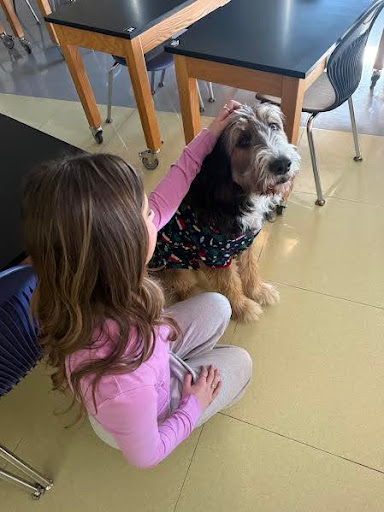
National “Take Your Dog to Work Day” has become a constant occurrence for two Liberty teachers. Clover and Dakota (Dak) are both trained therapy dogs that frequently visit the school.
Shelby Bryce (she/her), guidance counselor, brings Clover to school almost every Thursday. Jenifer Secrist (she/her), science teacher, has Dak come to school every day. Both of these therapy dogs are brought in with the hope of making the school a more comfortable space.
“Animals can have a different effect on humans than other humans can. And sometimes just being able to slow down and pet a friendly animal, and have that animal give you their undivided attention the way that Clover does, can make a sad day a bit better,” Bryce said.
Clover serves a purpose for many students at Liberty.
“When I bring Clover every Thursday, there are certain students at school that I make sure see her every time. We have a couple of students who don’t speak much at school, but when they see Clover, they light up, and it makes their whole day better,” Bryce said.
Dr. Colbert (he/him), principal at Liberty, agrees that the services Clover provides are beneficial
“The presence of Clover can be really calming. I think in the counseling office, [Clover’s] one of the biggest benefits. It’s just the ability that when a student is having a really hard time, if they are anxious, if they are really worked up, just the physical presence of a dog can be very therapeutic for a lot of kids,” Colbert said.
Dak is brought not only for other students, but for Secrist as well. He serves two purposes: to meet the health needs of Secrist and to provide an additional form of support for the students.
“It has been wonderful having Dak with me. He elicits so many smiles throughout the day. It is wonderful to watch students walking down the hall and their immediate reaction when they see Dak is instant happiness,” Secrist said.
Colbert shared that he has heard some of the most positive talk coming from Secrist’s room. He believes that because Dak is in that learning environment, it makes the students calmer and more focused.
The process of bringing a therapy dog to school is difficult and lengthy. Both Clover and Dak’s processes were mostly the same.
“Dak first took classes for behavior and then training and testing [to be certified] as a therapy support dog. Additionally, I have to apply to have Dak with me in the classroom, verify vaccinations and before each new year, I write an informational letter to each student’s family to have a proactive plan in case I have any dog allergies or fears,” Secrist said.
Bryce also had Clover go through a two-week training process in Illinois. She left four-month-old Clover at the Dogs for Life clinic for obedience and emotional support training. Clover received an emotional support certificate after all the work she put in. Bryce shared that the training Clover did at the clinic made her able to support students in such a way that humans can’t.
On some occasions, students may not want to be around a dog, or they could be allergic to them. This can be a setback for a classroom or office with a dog.
“Sometimes there are students or families that don’t want to be or feel comfortable being around a dog. The benefit of that is that we are in a very large school, so there are alternatives to make sure that a student can still feel comfortable,” Colbert said.
These therapy dogs are also expected to handle tough situations. Being in a classroom, students can become frustrated or not follow the teacher’s directions. This is a time for the therapy dogs to step in and help the situation.
“Dak has helped a number of students in a larger capacity over the two years. He has a beautiful ability to de-escalate behaviors. On a number of occasions, Dak has helped students emotionally regulate. Helping to get the student to class following feelings of frustration, noncompliance, and even fear,” Secrist said.
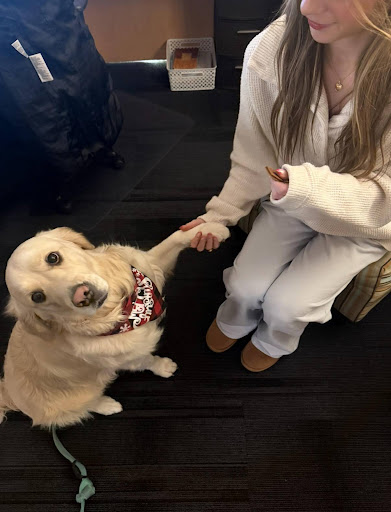
Bryce has worked on Clover being open with the number of people at school. She wants Clover to be able to help any student, whether it’s letting them talk to her or simply letting them pet her.
(Peyten Van Dyke)
“I want kids at Liberty to know that Clover is free for petting. If I’m there with her, and we’re kneeling down in the mornings, we’re basically saying come on over. And I want her to be extremely versatile in accepting the amount of people, without getting overwhelmed,” Bryce said.