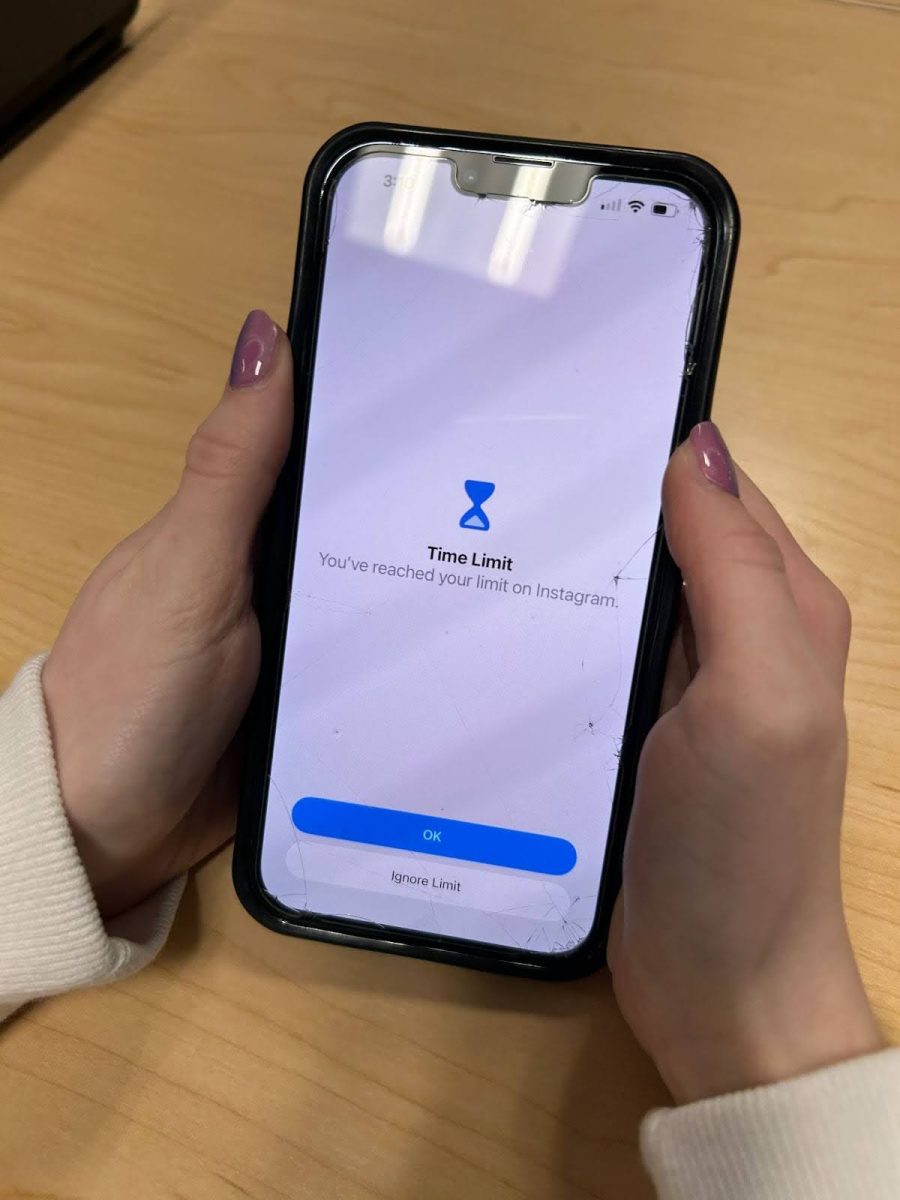
With the rise of technology usage in younger generations, parents have found ways to limit and monitor their children’s time on screens.
David McNair, a Spanish teacher at Liberty High School, has screen time limitations implemented on his daughter’s phone, and has found them to be very beneficial for developing a good relationship with technology at a young age.
“I reevaluate. In fact, my wife and I had this conversation last night, about going back in to reevaluate our limits. We do that periodically to determine if we want to give more time or less time. I’m constantly looking at, what is she doing on the phone? How is she using the phone? What are the apps she’s spending the most time on?¨ McNair said. “We also include her in that conversation… We sit down with her and talk about [her usage]. We want her to be part of the conversation because I think it’s very important not just to say no, but to have the why behind it and our rationale.”
Screen time limits are also versatile and may be adjusted by a guardian depending on a person’s situation.
“There are times where she’ll request more time [on apps] and I’ll give it to her. For example, we have a weekly schedule, but Tuesday we didn’t have school, so Monday night I let her have some more time.” McNair said.
Although screen time restrictions have the potential to limit screen usage, these limitations may be unreliable without proper enforcement. Students have found that there are many ways around these restrictions, such as figuring out the screen time password, FaceTime screen-sharing and even creating an entirely new Apple ID.
“Because there are so many ways around [screentime restrictions], I’m not exactly sure that it [helps with productivity], but I think that it could help if it’s done right,” said Eleanor Johnson, 9.
Screen time limitations can be beneficial to parents looking to control their children’s device usage; however, they also have their fair share of drawbacks. Neva Jensen, 10, believes that screen time limitations have the potential to be a hindrance, and even a possible safety hazard.
“One time I drove to Solon… and on my way home, I plugged [my address] in on maps, because I wasn’t sure how to get home, and then at 11:30 my screentime shut off, so I was unable to access maps and I had no way of figuring out how to get home on my phone, and my mom was asleep, so I couldn’t ask for more screen time… luckily I got home okay, but if that had have happened in any other place I could have gotten stranded,” Jensen said.
Kaelyn Clark, (she/her) 10, who also has screen time restrictions on her school-issued computer and other devices, shares Jensen’s reservations.
“Sometimes the restrictions on [my school computer] can interfere with me getting my schoolwork submitted on time…if i’ve been really busy the whole day and I get home later after sports or school-related activities and I have to do an assignment and get it submitted by 11:59, but my computer shuts off at 11, then I really struggle with that because then I have even less time,” Clark said.
Alongside screen time restrictions, many guardians have also adopted the usage of cellular tracking through built-in phone programs or apps such as Life360.
“I got [Life360] a couple of years ago because my mom forced me to get it…she’ll constantly track my sister when she’s driving and she can see if she’s on her phone while she’s driving, if she’s speeding, where she’s going…and she gets notifications whenever my sister and I get anywhere,” Clark said.
These tracking features are useful for parents wanting to keep tabs on their children, but students have found them to be somewhat of an invasion of privacy.
“I get that my parents want to know where I am at all times for my safety, but I don’t like that it’s become such a huge thing in my life,” Clark said.
Although screentime limitations and cellular tracking are imperfect solutions, younger generations continue to face the impacts of increasing device popularity.
“I would say that screentime is selective and it should be used for kids who need it, not for parents just to have controls over their kids,” Clark said. “If your kid is trustworthy and responsible, you shouldn’t need it, but if your kid struggles to manage their screentime, and struggles to keep their grades up because of their screentime, then I think it’s necessary.”